Launch of the Urban Living Lab in Marseille
On January 29th, the City of Marseille officially launched the Urban Living Lab in the Saint-Pierre district, marking the start of an ambitious participatory process in the heart of the 5th arrondissement. This first milestone brought together residents, local stakeholders and institutional partners around a shared objective: collectively exploring pathways for the energy and ecological transition of the neighbourhood, grounded in everyday practices, lived experiences and local priorities.
This launch is part of a long-term, district-based process designed to be open, progressive and deeply rooted in the territory.
Reaching out to residents ahead of the launch
Prior to the event, a proactive “aller-vers” outreach strategy was implemented to broaden participation and engage residents and users of the neighbourhood who may not usually take part in formal consultation processes. Outreach actions were carried out at schools, near public transport stations, in key neighbourhood spaces such as squares, local shops and everyday meeting places.
These on-site exchanges made it possible to introduce the Urban Living Lab approach, invite people to upcoming activities and begin listening to residents’ perspectives on the future of their neighbourhood, structured around four key themes:
- Housing and energy: energy sobriety, building renovation, local energy production;
- Summer comfort: overheating in homes, cooling islands, shading, living better during heatwaves;
- Nature in the city: trees, vegetation, local biodiversity, shared spaces;
- Mobility: active and low-carbon mobility, traffic calming, safer everyday journeys.
An open, participatory and educational launch event
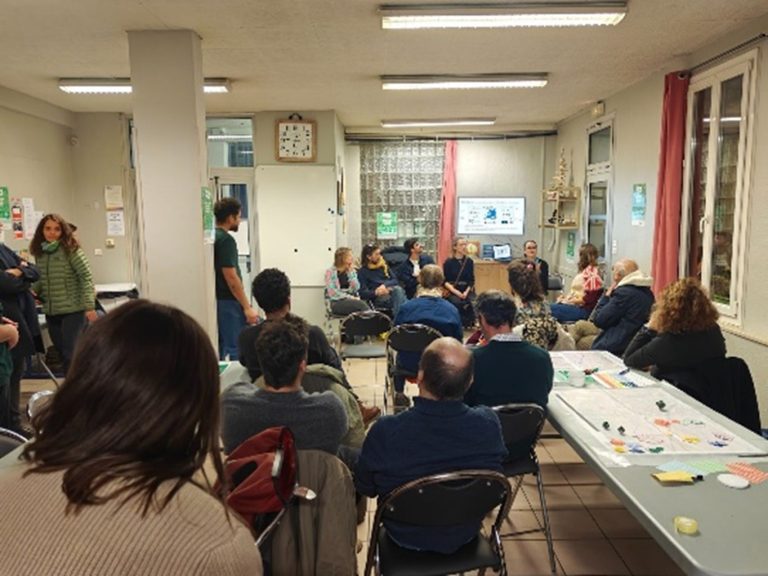
The launch event took place at the CMA Saint-Pierre and was designed as an accessible, welcoming and interactive moment, combining information, discussion and hands-on participation.
A roundtable discussion to set the scene
Following a presentation of the approach, a roundtable discussion brought together several key partners involved in Marseille’s ecological transition: ALEC (Local Energy and Climate Agency), Mission Marseille 2030 (Climate City Contract), Cité des Transitions (network of associations and actors committed to ecological transition), Ateliers Blancarde (iconic neighborhood third-place), and ADEME (National Agency for Ecological Transition),
The discussion addressed the challenges of neighbourhood-scale energy transition, existing support mechanisms for residents, and the complementarity between institutional action and citizen-driven initiatives.
A participatory forum to express expectations
The second part of the evening took the form of a participatory forum with several open activities designed to collect insights and encourage dialogue.
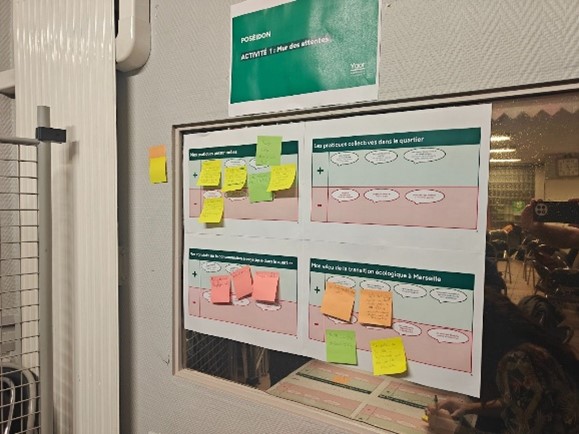
The “Expectations Wall”
The Expectations Wall invited participants to reflect on and share:
- their individual practices related to housing (heating, water and electricity use, everyday sobriety, difficulties in changing habits);
- collective practices within the neighbourhood (mobility, use of public space);
- observations on local energy consumption, including energy losses and the identification of refuge spaces during heatwaves or cold spells.
Nos Gestes Climat workshop
Developed by ADEME, the Nos Gestes Climat activity provided a clear and engaging way to understand the main orders of magnitude of individual carbon footprints. Through a pedagogical and playful approach, participants also received personalised suggestions for concrete actions to reduce their environmental impact.
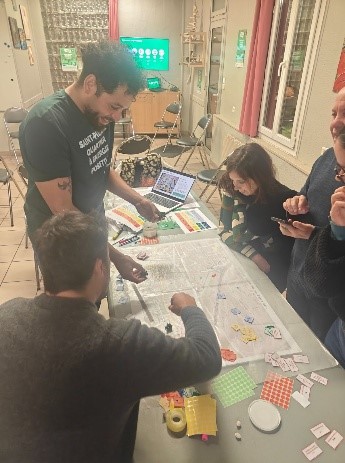
Participatory mapping
A large printed map of the Saint-Pierre district served as the basis for a detailed collective exercise, structured around several themes:
- Energy production and infrastructure: opportunities for renewable energy production, solar panels, rooftop potential, connection to district heating networks;
- Buildings, facilities and consumption: renovation priorities, energy-inefficient buildings, low-energy lighting (LED), solar protection and shading;
- Mobility, flows and logistics: safe cycling routes, pedestrian paths, shared delivery areas, electric charging stations, public transport stops;
- Public spaces and everyday places: accessible cooled spaces in summer, water and cooling points, greening and vegetation.
Two layers were explored simultaneously: the current situation and a desired future vision, helping to build a shared and forward-looking perspective for the neighbourhood.